
Explore a new way of understanding time and reality — calmly, clearly, without dogma.
Constant Time Theory
A new way to understand time, existence, and the structure of reality.
What if reality is being rebuilt 1.85×10⁴³ times every second?
It sounds absurd at first — reality refreshing itself faster than anyone could ever count. And yet the more closely we examine time, the more this idea begins to make sense. CTT explores what the universe looks like when we stop imagining time as a river, and start treating it as the constant force that rebuilds everything, including us.
Why this matters: Because how we understand time shapes how we understand meaning, identity, and what truly endures.
Read That Which Endures to explore meaning beyond belief — and discover what still holds when certainty falls away.

Time Moves Quickly. Our Emails Won’t.
Leave your details if you’d like thoughtful, occasional updates on Constant Time Theory.
Does Time Really Flow?
Why Screens Refresh Instead of Flow
We often speak about time as though it flows — like a river carrying us forward.
It feels continuous, smooth, uninterrupted. That metaphor is so familiar that it rarely gets questioned.
Yet when humans came to build machines that simulate reality in motion, something curious happened.
They didn’t build flow.
They built refresh.
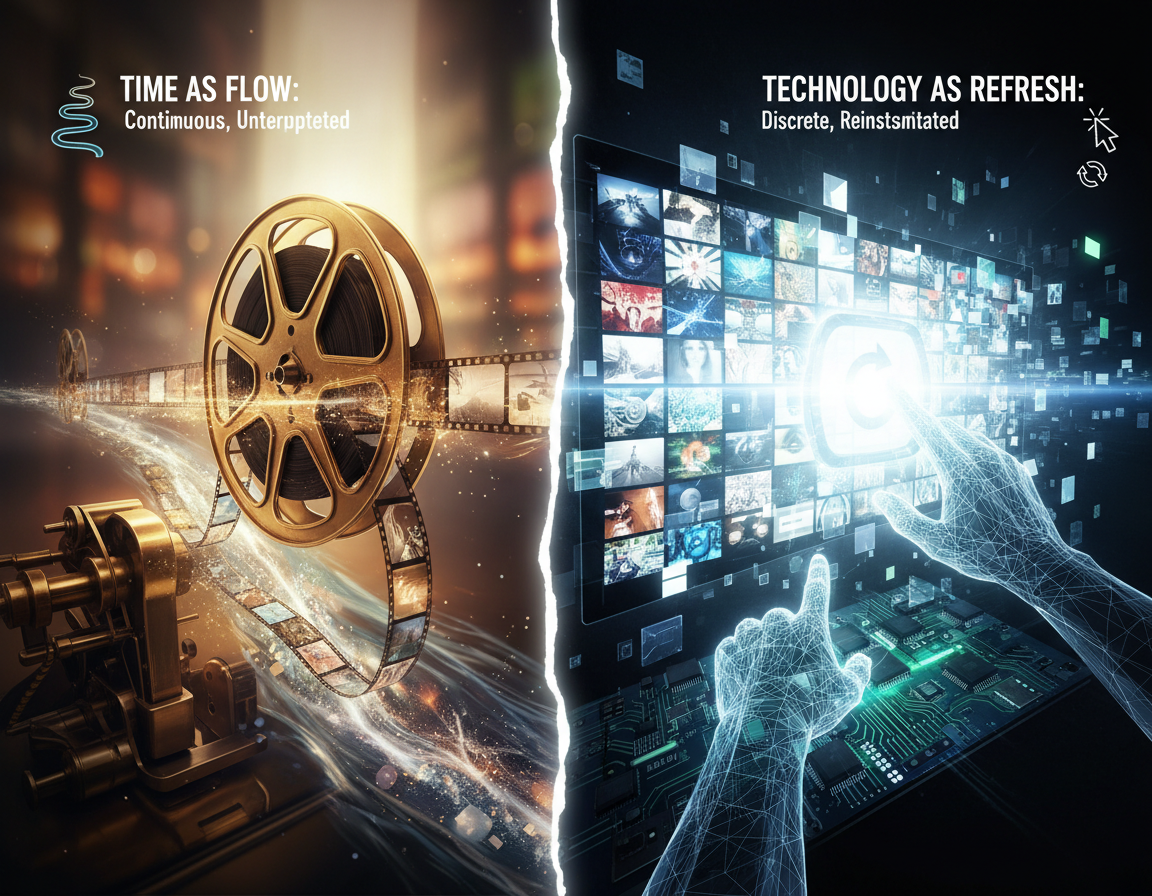
A television screen does not carry an image forward from one moment to the next.
It reconstructs the image again and again — frame by frame — at a fixed maximum rate. Continuity is not inherent to the screen; it emerges when the refresh is fast enough.
The same is true for film, digital video, audio, and computation.
Whenever humans attempt to create persistence, motion, or change, they do not discover flow — they discover reinstantiation.
This is not a coincidence.
No one sat down and said, “Let’s make this behave like time.”
Engineers were simply constrained by what could remain stable, coherent, and intelligible. And under those constraints, the same pattern always emerged:
a maximum update rate, discrete renewal, and the illusion of continuity born from speed.
In Constant Time Theory, time is not something that moves. It is something that renews. Reality persists because structure is repeatedly re-established within a temporal field at a finite maximum rate. What we experience as smooth passage is the mind stitching together successive instantiations.
What is striking is not that we misunderstood time — but that we unconsciously mirrored it.
When humans try to build continuity, they rediscover the same rule again and again:
there is a fastest rate at which structure can be renewed and still endure.
We could imagine a flowing screen, in theory — an image that truly slides from moment to moment with no refresh, no frame, no boundary. But such a thing has never been built, because it cannot be made stable. Flow is a description of experience, not a method of construction.
In that sense, our technologies quietly confess something our metaphors obscure.
Time does not carry reality forward like a river.
It holds reality together by renewing it — relentlessly, patiently, and just fast enough that we mistake renewal for flow.
“We experience time as flow, yet everything we build that endures is renewed.”